When compared to the historical record of what befell these leaders, a whopping 73.6 percent, 27 leaders on the CIA list, lost power as a result of assassinations, coups, untimely deaths, and mass popular revolts engineered from abroad.
CIA’s 1985 list of vulnerable Third World leaders: 27 of 38 were ousted through coups, revolts, or death
| Bahrain | Isa bin Sulman al Khalifa. Died of heart attack, 1999, after meeting U.S. Secretary of Defense William Cohen |
| Benin | Mathieu Kerekou. Ousted in civilian coup, 1990 |
| Bhutan | Jigme Singye Wangchuck. Abdicated 2006 |
| Burma | U Ne Win. Ousted, internal coup, 1988 |
| Chile | Gen. Augusto Pinochet. Stepped down in negotiated agreement, 1988 |
| Cuba | Fidel Castro. Resigned in 2006 during grave illness |
| Gambia | Dawda K. Jawara. Ousted, CIA coup, 1994 |
| Guyana | Forbes Burnham. Died after throat surgery at Georgetown Hospital, Washington, DC, 1985. Originally inserted by CIA after coup against British Guiana’s Marxist prime minister Cheddi Jagan |
| Haiti | Jean-Claude Duvalier. Ousted in CIA coup, 1986 |
| Indonesia | Suharto. Resigned during mass demonstrations, 2003. Originally inserted into power by CIA coup in 1965 |
| Lesotho | Leabua Jonathan. Ousted in military coup in 1986 |
| Libya | Muammar Qaddafi. Executed in 2011 by CIA-supported rebels |
| Malawi | H. Kamuzu Banda. Ousted by popular revolt 1993 |
| Mali | Moussa Traore. Ousted by popular revolt 1991 |
| Nepal | Birendra Bir Bikram. Assassinated in CIA-backed coup 2001 |
| Niger | Seyni Kountche. Died in Paris hospital of brain tumor, 1987 |
| Paraguay | Alfredo Stroessner. Ousted in coup, 1989 |
| Philippines | Ferdinand E. Marcos. Ousted in popular revolt, 1986 |
| Qatar | Khalifa bin Hamad al Thani. Ousted in palace coup, 1995 |
| Rwanda | Juvenal Habyarimana. Assassinated in CIA-linked aircraft shoot down, along with Burundi President Cyprien Ntaryamira, 1994 |
| Somalia | Mohammed Siad Barre. Ousted in revolt in 1991 |
| Sudan | Gaafar al Nimeiry. Ousted in coup in 1985 |
| Syria | Hafez al Assad. Died in 2000. His son, Bashar al Assad, faced CIA-backed civil war in 2011 |
| Vietnam | Le Duan. Died of heart attack suffered during 27th Communist Party Congress during party schism |
| Zaire | Mobutu Sese Seko. Ousted in CIA-led foreign invasion in 1997 |
| Zambia | Kenneth Kaunda. Forced from office by international pressure in 1991 |
The CIA even ranked the vulnerability of the above leaders. The leaders of Burma, Morocco, and Tunisia were considered among the most vulnerable in 1985, with those of the Philippines, Somalia, Sudan, and Zambia closely following. The least vulnerable leaders were those of Qatar, Rwanda, Togo, Oman, Bhutan, Benin, and Nepal.

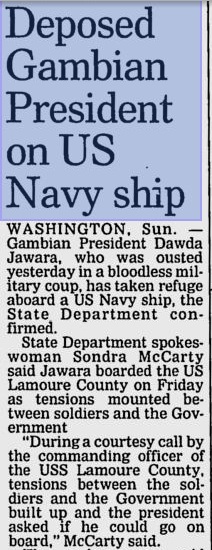
Gambian President Dawda Jawara was overthrown in a 1994 U.S.-backed military coup while he was on board the visiting U.S. Navy ship, the USS Lamoure County, docked in Banjul harbor.
The CIA report concluded that “U.S. interests are substantial in about two-thirds of these high-risk cases — Chile, Indonesia, Morocco, the Philippines, Somalia, Syria, and Tunisia.” The report strongly suggests that whether a Third World regime was “friendly or antagonistic to U.S. interests” any political instability that would affect U.S. strategic or economic interests would be grounds for the U.S. to seek the removal from power of friend or foe. In this regard, the CIA report cited “Cuba, Indonesia, Jordan, Libya, Morocco, North Korea, the Philippines, Singapore, Somalia, Sudan, Syria, Tunisia, and Zaire as “important to the United States.”
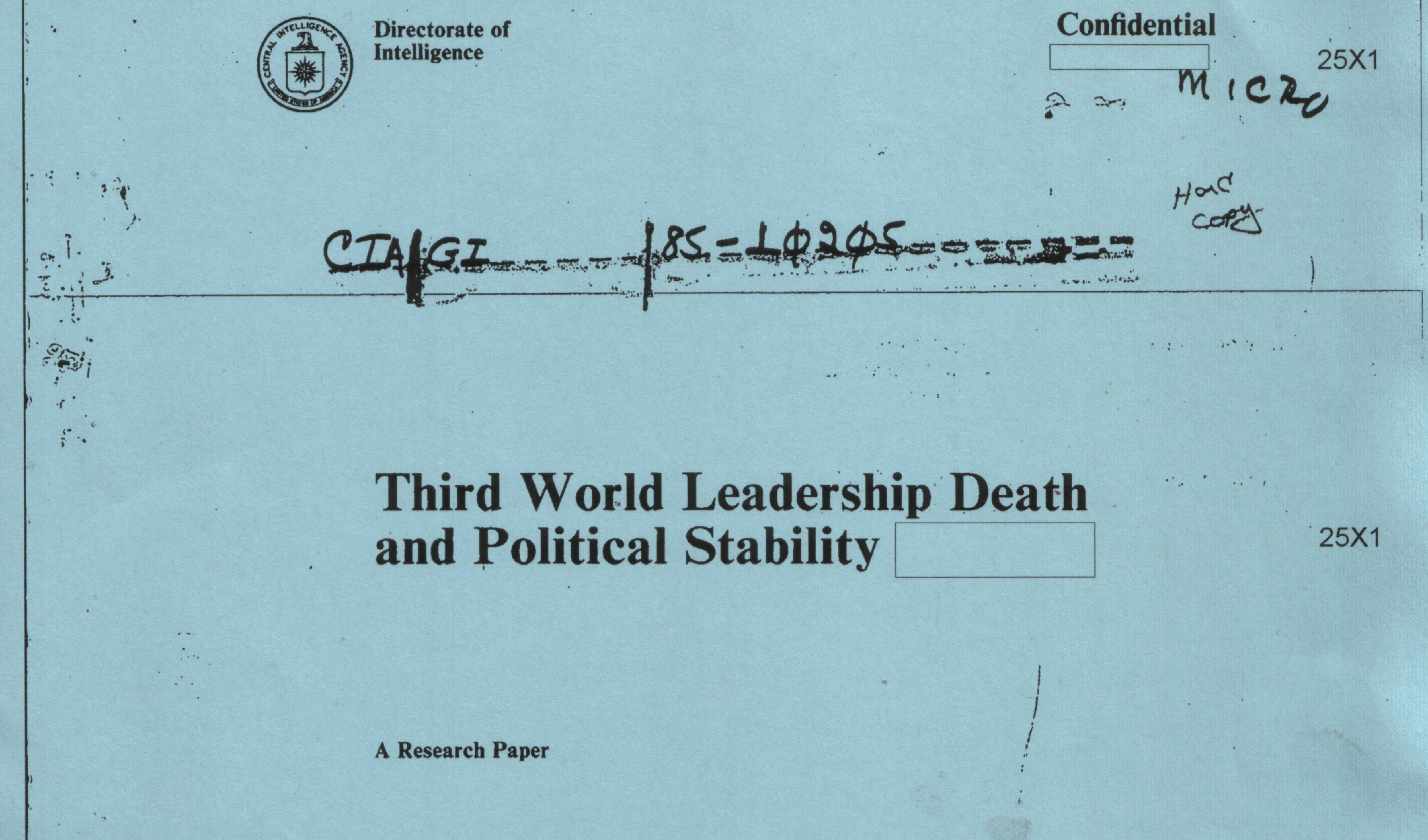
Perhaps in what was an early recognition of the power of civil society organizations to create political instability, something that was later employed by the CIA, George Soros, and Gene Sharp against governments in Serbia, Georgia, Ukraine, Egypt, Tunisia, Kyrgyzstan, and Tunisia, the CIA report states: “Greater instability occurred in countries where social organizations were able to mobilize their constituents — South Korea, Spain, Portugal, Egypt, and the Dominican Republic.”
The CIA considered Tunisia under President Habib Bourguiba ripe for post-succession turmoil. Bourguiba was a special target because of his links to “revolutionary regimes dominated by longstanding charismatic leaders like Ho Chi Minh of Vietnam, Mao Zedong of China . . . Tito of Yugoslavia.” All except Bourguiba were Communists. Marcos pf the Philippines was likened to one of aging oligarchs who, in their older years, became problems for the United States. In addition to Marcos, these leaders cited by the CIA included Franco of Spain and Hafez al Assad of Syria.
The CIA interest in fomenting insurrections against world leaders, which, in some cases, would lead to assassination, was in direct violation of three presidential executive orders barring the CIA from involvement in any way with political assassinations. The orders were EO 11905 signed by Gerald Ford; EO 12036 signed by Jimmy Carter, which barred even indirect CIA involvement in political assassinations; and EO 12333, signed by Ronald Reagan. In 1998, Bill Clinton reinterpreted the assassination ban and permitted assassinations as long as there was a counter-terrorism predicate. After 9/11, George W. Bush authorized the CIA to kill anyone the CIA placed on its Worldwide Attack Matrix. Barack Obama has done nothing to change the Bush policy on political assassinations.
# # #
Wayne Madsen is author of “Manufacturing of a President: The CIA’s Insertion of Barack H. Obama Jr. Into the White House” as well as several other books on the NSA and the Patreaus Affair. He is a Washington, DC-based investigative journalist, author and syndicated columnist. He has written for several renowned papers and blogs. Madsen is a regular contributor on Russia Today. He has been a frequent political and national security commentator on Fox News and has also appeared on ABC, NBC, CBS, PBS, CNN, BBC, Al Jazeera, and MS-NBC. Madsen has taken on Bill O’Reilly and Sean Hannity on their television shows. He has been invited to testifty as a witness before the US House of Representatives, the UN Criminal Tribunal for Rwanda, and an terrorism investigation panel of the French government. As a U.S. Naval Officer, he managed one of the first computer security programs for the U.S. Navy. He subsequently worked for the National Security Agency, the Naval Data Automation Command, Department of State, RCA Corporation, and Computer Sciences Corporation. Madsen is a member of the Society of Professional Journalists (SPJ), Association for Intelligence Officers …